Bozak Cma-10-2dl Manual
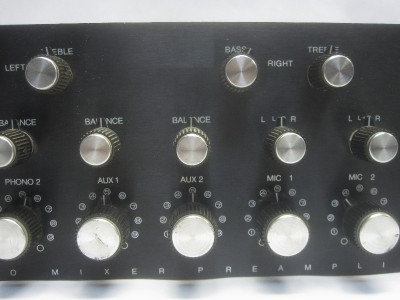
The Rifles No Love Lost Download Season. You should really read the manual.;). Began to appear DJ specific technology, such as the classic mixer 'CMA-10-2DL mixer ' Rudy Bozak. Rudy Bozak was one of the all time great audio pioneers spanning the 1930's to the 1970's. During the 50's and 60's the musical map was changing forever, from Rock n Roll to RnB and in the 70's, RnB then went up-tempo and Disco was born. The rest is pure club land history. The Bozak CMA-10-2DL was the first.

Bozak cma 10 2dl Mixer, PSU transfo voltage. 2007, 12:56:34 PM ». I have a CMA-10 (not the dj version), and I believe the dc voltage after rectification was somewhere in the range of 35-39V. Anyone else who might be interested in the manual and schematics can find them HERE. That Bozak in the picture above is not a CMA-10-2DL, it's a AR-6 It's a new Bozak which not a true Bozak either, Rudy Bozak.
'Bozak' redirects here. For the hockey player, see.
Rudolph Thomas Bozak Born 1910 Died ( 1982-02-08)February 8, 1982 (aged 72) Residence Other names Rudy Bozak, R. Bozak, Rudi T.
Bozak Occupation Engineer, designer, entrepreneur, owner Employer Cinaudagraph Dinion Coil Company R. Spouse(s) Lillian Gilleski Children Lillian, Mary and Barbara Rudolph Thomas Bozak (1910–1982) was an audio electronics and acoustics designer and engineer in the field of sound reproduction. His parents were Czech immigrants; Rudy was born in. Bozak studied at; in 1981, the school awarded him an honorary doctorate in engineering. Bozak married Lillian Gilleski; the two had three daughters: Lillian, Mary and Barbara.
Contents • • • • • • • • • • • • • Loudspeakers [ ] Fresh out of college in 1933, Rudy Bozak began working for, an electronics manufacturer based in. Bozak would later employ Allen-Bradley components in his own electronic designs. Bozak moved to the in 1935 to work for Cinaudagraph out of.
Two years later he was chief engineer. At the, a tower topped with a cluster of eight 27' Cinaudagraph loudspeakers in 30' frames with huge 450 lb. Magnets covered low frequency duties for a 2-way PA system. The loudspeakers were mounted into horns with 14' wide mouths and were each driven by a 500 watt amplifier derived from a high-power radio broadcast tube.
In June 1940, Electronics magazine published an article that Bozak had written about the design of the 27' loudspeaker. During, Bozak worked with at Dinion Coil Company in developing very high voltage power supplies for radar. Bozak joined in 1944 to help them develop an. While in, he noticed that the human sense of hearing was unpredictable at best. Years later, Bozak recounted this story about the Conn electronic organ project: 'The general sales manager, who was a pianist and played organ, sat down and played the thing and said it was great, just what we were looking for. A week later he was invited back into the laboratory and sat down and played the instrument again. He didn’t play ten or fifteen bars when he said, This goddamn thing doesn’t sound right.
What did you guys do to it?’ We said we hadn’t done anything. Well, he didn’t believe us. ‘You did something to it. You messed it up here,’ he said.
‘Restore it back to the way you had it.’ So what we did was let the damn instrument sit there for another week, and he comes back and plays it again. ‘Now this is the way it should be,’ he says.' In 1948 Bozak moved his family to to develop organ loudspeakers for. While there, Bozak experimented at home in a loudspeaker laboratory he housed in his basement.
One design of his featured a shell as the loudspeaker enclosure. In 1950 Bozak was hired as a consultant by to develop a square loudspeaker driver unit but it was not an engineering success. In 1952 he was making driver units for the McIntosh F100 speaker system.
Though these sold reasonably well, McIntosh did not develop the design further. This experience led him to form his own company, Bozak Loudspeakers, in. Bozak met in the early 1950s; the two hit it off and began working in a shared warehouse basement facility in Stamford. Max Mclean Esv Audio Bible Download here. Cook and Bozak thrilled the audio world in 1951 with Cook's ground-breaking stereo recording of train sounds at night: Rail Dynamics. Together, Bozak and Cook implemented a stereo loudspeaker system that would be able to show Cook's stereo recordings to best effect. By the mid-1950s, Bozak had expanded into new quarters at 587 Connecticut Avenue in, with an export office in.